Writings

Writings

Selected articles, journal contributions, and magazine pieces.

7 entries
Stabilising Cooling, Privatising Knowledge — slide 1
01/06
Writing

Stabilising Cooling, Privatising Knowledge

Each year, Taipei's Nangang Exhibition Center becomes the heart of the global computing industry during COMPUTEX, a major trade show where leading tech giants – Nvidia, Intel, TSMC, ASUS, MSI, and G.SKILL – unveil their latest innovations. Spanning developments in AI, gaming, and cooling technologies, COMPUTEX highlights the relentless pursuit of computing power, enabled by semiconductors. Among the show's most anticipated events is liquid-nitrogen overclocking – a niche yet competitive subculture where extreme gamers push CPUs and GPUs beyond their limits, using cryogenic cooling techniques to extract maximum power. Sponsored by hardware manufacturers, these overclockers compete by manipulating temperature-sensitive circuits while navigating the risks of condensation, hardware failure, and the ever-evolving constraints of semiconductor technologies. Beyond the hype and superficial spectacle of COMPUTEX, it serves as a microcosm of broader industrial trends: the commodification of computational thermal control, the corporate influence on hacker culture, and the gradual shift towards closed-source hardware design. What begins as a ritual of extreme cooling ultimately reveals the intricate power and labour at play in shaping the future of computing and our computational culture.

Dismantle and Dissolve, (Re)build, Remix — slide 1
01/04
Writing

Dismantle and Dissolve, (Re)build, Remix

This contribution follows a four-year investigation (2022–2026) into the political economy of graphics card miniaturization. It begins from the premise that rethinking our relationship to artificial intelligence and its sociotechnical entanglements requires demystifying and opening the black box of this technical object. Within our algorithmic culture, the graphics card (GPU) enables the massive, parallel processing of large datasets, making possible the training of the models that underpin our intelligent systems. GPU miniaturization is equally crucial: as a key driver of the Internet of Things, this sociotechnical phenomenon enables the inclusion of these cards in increasingly compact and powerful systems while also enabling better management of energy resources. The development of these everyday objects and technologies nevertheless reinforces several major problems. Drawing on both the social sciences and the critical, reflexive, speculative, and fictional methodologies of research-creation, the author developed several investigative fieldwork sites—among liquid nitrogen overclockers in Taiwan and urban miners in Ghana—and conducted situated experimentations on some fifty acquired graphics cards. Structured around three themes (dismantle and dissolve, rebuild, remix), this paper demonstrates how research-creation methods constitute full epistemologies for apprehending what seems a priori external, opaque, or inaccessible, and for restoring artificial intelligence to its tangible materialities. In doing so, it contributes to the field of ICT for sustainability by affirming research-creation as a rigorous means of disentangling the material and environmental infrastructures that computational systems both depend on and obscure.

teti — slide 1
01/03
Writing

teti

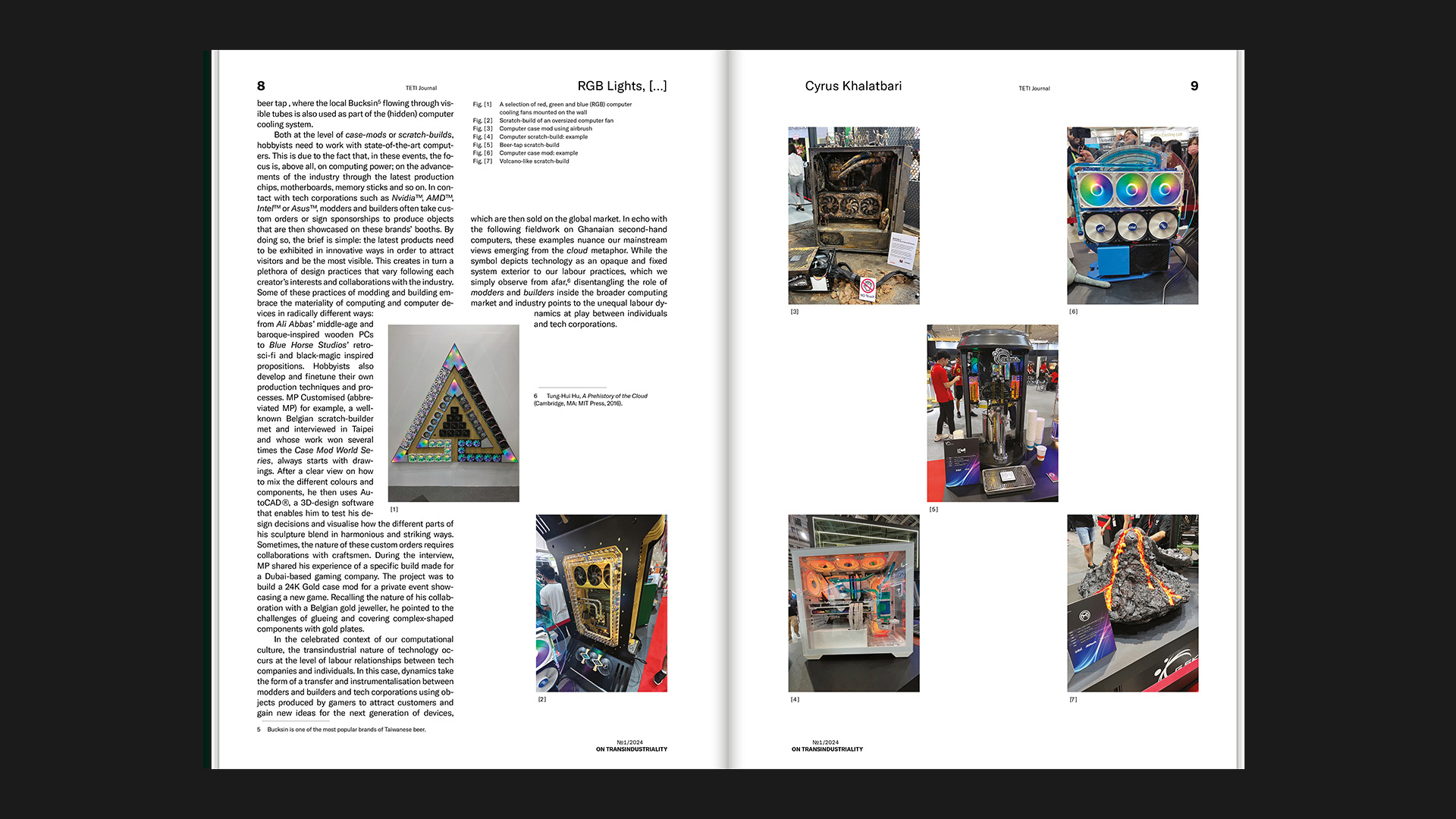
Our algorithmic media landscape is driven by the miniaturisation of smartness, a process centred on embedding computational power into increasingly compact and efficient devices. At the core of this transformation lies the Graphics Processing Unit (GPU), a hardware originally designed for video games and graphics acceleration but now integral to AI and computational parallelisation. This article examines the materiality of GPUs and their miniaturisation process by connecting two communities at the opposite ends of the devices' lifecycle. On one end are liquid-nitrogen overclockers in Taipei, Taiwan, who push computational limits through extreme cooling practices; on the other are urban miners in Agbogbloshie, Ghana, who recycle and repurpose discarded GPUs. By uncovering the material, environmental, and knowledge infrastructure of GPUs, this study reveals smartness as rooted in geological, thermal and sociotechnological entanglements, in contrast to the dominant narratives of AI around immateriality, universality and neutrality. Through three analytical sections – Process and Circulation, Embodied knowledge, and Prototypes – this article uncovers how miniaturisation shapes and is shaped by labour, a desire for optimisation, and stratified economic relations. It ultimately argues that the drive for computational efficiency is inseparable from exploitative dynamics, reinforcing vertical hierarchies between tech corporations and local communities.

From Cloud Aesthetics to Alternative Circuits and Assemblages — slide 1
01/03
Writing

From Cloud Aesthetics to Alternative Circuits and Assemblages

From the seminal "cloud" metaphor to green buttons and blue thumbs-up emojis, our interactions and dominant discourses around the digital embody a specific capitalistic agenda: the one of technology as a commodity fetishism we simply consume and later trash without understanding how it operates. In addition, these interfaces and metaphors hide the complex human, material and environmental assemblages enabling, operating and optimising our digital processes. Drawing from this context, the article is intended for artists and interaction designers interested to critically engage with technology and their "blackboxes". It argues for the importance of bridging design with social sciences and ethnographic fieldwork. Through this lens, it posits that designers can, first, better understand the lifecycle and infrastructures of our electronic objects as well as, second, create artefacts that nuance and critique these dominant narratives and beliefs around digital "immateriality".

From the Cloud to the Landfill — slide 1
Writing

From the Cloud to the Landfill

This contribution sheds light on discarded electronics repair in Accra, Ghana. After placing these practices in dialogue with the Western and Eurocentric narratives around the materiality of digital interactions and infrastructure, it delves into two arts and design contexts that gravitate around the electronic waste landfill and processing site of Agbogbloshie (Ghana). The first case study is the Agbogbloshie Makerspace (AMP), a critical making (and unmaking) platform empowering local repairers and dismantlers through open-source collaborative design methods. The contribution then focuses on the work of Akwasi Bediako Afrane, a Ghanaian media artist who re-appropriates discarded computers to critique and speculate on our sociotechnical condition. Situating these initiatives in the light of our broader dominant internet and computing narratives, the article situates the importance of these practices in order to tackle and raise awareness about the planetary electronic waste condition we live in.

Extractivism, gendered-computing and online queer spaces — slide 1
Writing

Extractivism, gendered-computing and online queer spaces

This contribution sheds light on discarded electronics repair in Accra, Ghana. After placing these practices in dialogue with the Western and Eurocentric narratives around the materiality of digital interactions and infrastructure, it delves into two arts and design contexts that gravitate around the electronic waste landfill and processing site of Agbogbloshie (Ghana). The first case study is the Agbogbloshie Makerspace (AMP), a critical making (and unmaking) platform empowering local repairers and dismantlers through open-source collaborative design methods. The contribution then focuses on the work of Akwasi Bediako Afrane, a Ghanaian media artist who re-appropriates discarded computers to critique and speculate on our sociotechnical condition. Situating these initiatives in the light of our broader dominant internet and computing narratives, the article situates the importance of these practices in order to tackle and raise awareness about the planetary electronic waste condition we live in.

9,1 gigahertz — slide 1
Writing

9,1 gigahertz

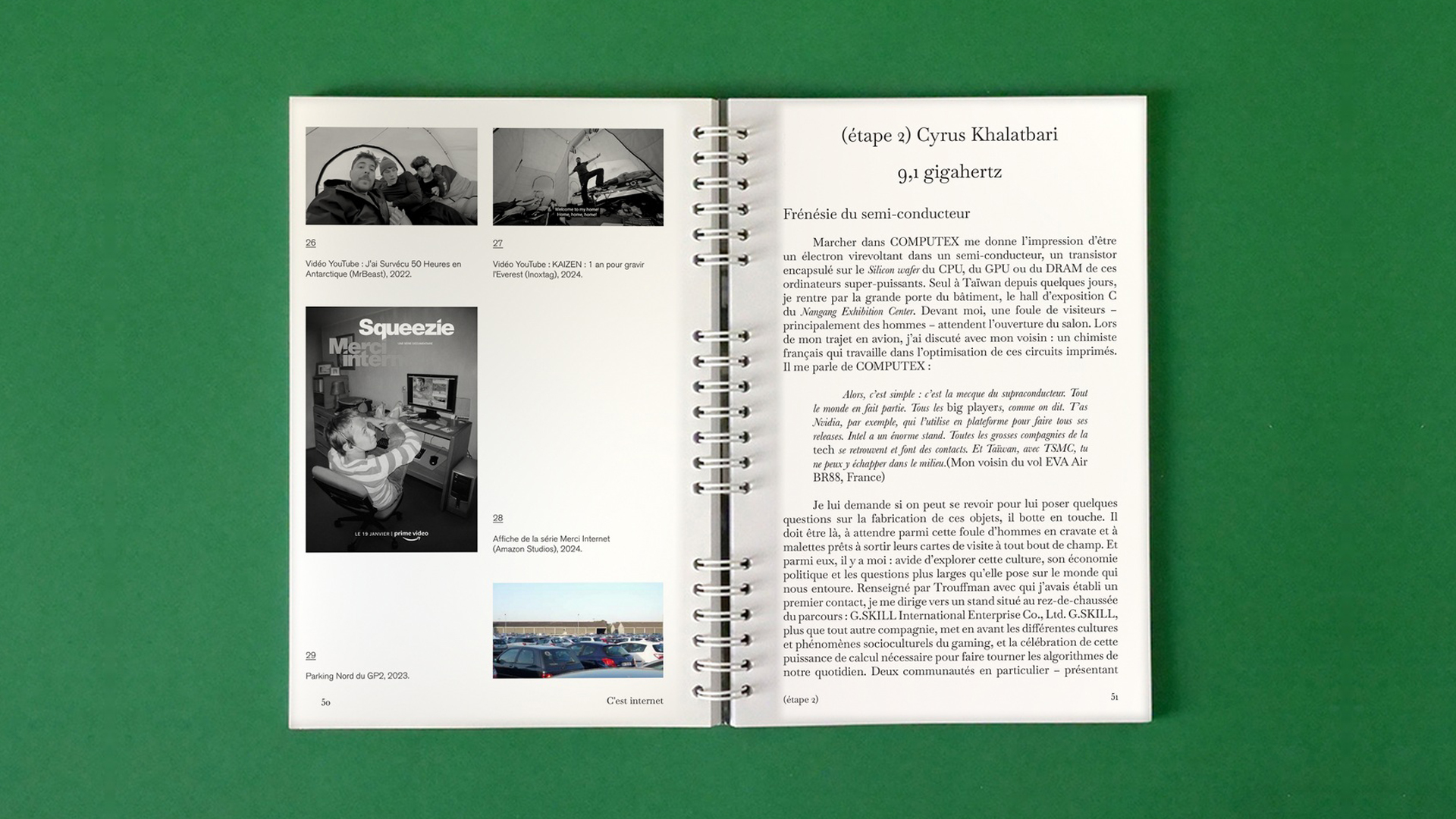
From the seminal "cloud" metaphor to green buttons and blue thumbs-up emojis, our interactions and dominant discourses around the digital embody a specific capitalistic agenda: the one of technology as a commodity fetishism we simply consume and later trash without understanding how it operates. In addition, these interfaces and metaphors hide the complex human, material and environmental assemblages enabling, operating and optimising our digital processes. Drawing from this context, the article is intended for artists and interaction designers interested to critically engage with technology and their "blackboxes". It argues for the importance of bridging design with social sciences and ethnographic fieldwork. Through this lens, it posits that designers can, first, better understand the lifecycle and infrastructures of our electronic objects as well as, second, create artefacts that nuance and critique these dominant narratives and beliefs around digital "immateriality".